A look at the latest HMDA data
January 2025
Over the next four years, the CFPB is likely to continue the more industry-friendly approach it adopted during the first Trump administration. However, the agency may still act aggressively against egregious violations of consumer protection laws, as it did previously. This approach resembles highway police tolerating moderate speeding while cracking down on drivers going at dangerously excessive speeds, where the potential for harm is greatest. To avoid fines, firms should ensure they do not fall into the "high-risk" category, which will almost certainly attract more scrutiny.
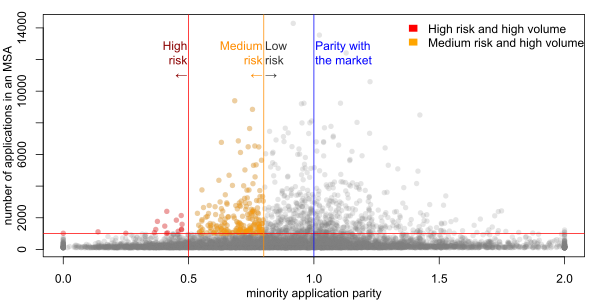
Let's take a look at mortgage lending to minorities using the last year's HMDA data. The benchmark is the "average lender" (i.e., "market") performance. Does an institution lend to minorities more or less than the market? An institution should not be significantly below the market (i.e., receiving fewer applications or approving fewer loans to minorities). An institution should not be significantly above the market either, as this is reverse discrimination. Ideally, each lender should align with the market, but this is not the case, as the figure below shows.
- Each data point is an observation of some institution in one of the 413 metropolitan areas ("MSA") in the U.S. where it received more than 100 applications. Fairness is measured by parity with the market in a given MSA, i.e., the minority share in the institution's lending relative to the minority share in lending of all institutions operating in the MSA.
- The distribution of parities in the figure is centered around 1, as expected. However, some institutions do not lend to minorities at all (zero parity), while some lend more than the market (parities above 1).
- The figure identifies institution-MSA pairs in which lending to minorities is economically and statistically significantly different from the market. In 2024:
- 800 institutions had parities below 0.5 (i.e., significantly underperforming the market) in at least one MSA, 687 are depository institutions or their subsidiaries/affiliates.
- 14 institutions marked with red ("high risk") had parities below 0.5 in at least one MSA with 1000 applications or more, i.e., they underperfomed at-scale.
- Economically significant deviations from parity are almost always statistically significant. Of 1350 parities below 0.5, 99% were statistically significant at the 95% confidence level.
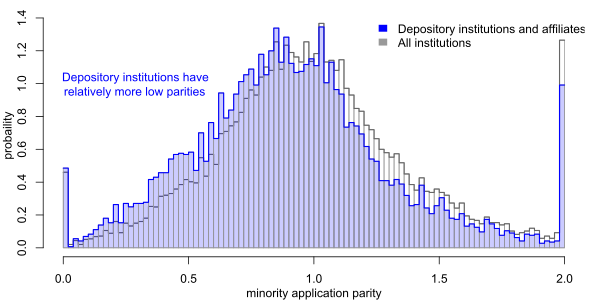
Interestingly, banks perform worse in lending to minorities than non-bank lenders.
- The distribution of parities worsens when one excludes mortgage lenders unaffiliated with banks: e.g., the mean parity shifts from 1.0 to 0.917, and the proportion of institutions with parity of 0.5 or less increases from 8.5% to 12.5%, which is material.*
- Of the 14 high risks identified above, only one is a non-bank lender. Some of the lowest parities correspond to large banks with thousands of applications/loans in a single metropolitan area.
What should banks do?
- Understand your performance, including if disparities are persistent or deteriorating.
- Compare to various peer groups, not just the market.
- Look beyond HMDA, especially marketing, exceptions, and complaints data.
- Leverage analytics to identify the best options to remediate (where to increase marketing, hire loan officers, expand self-testing?) and estimate the associated costs.
* The spike at parity=2.0 includes all observations at 2.0 and above.
Read a version of this insight on IBM Promontory Blog.
Read other insights: